
August 27, 2026
A listing crossed the market recently on a 54,581 square foot lot in Hunters Creek Village. The description was blunt about the house sitting on it: the structure was uninhabitable, the copy said, offering a rare opportunity for a complete rebuild. The price was not discounted for that condition. It was priced like everything else nearby.
If you did what most buyers do and divided the asking price by the square footage of that unlivable house, you would get a number that looks absurd. Too high for a teardown. Too high for anything, unless you already understand what is actually being sold.
That is the confusion this piece is here to clear up. In most Houston neighborhoods, price per square foot is a reasonable shorthand for house quality. In Hunters Creek Village, it measures something closer to nothing at all, because the house is frequently not the asset. The half acre under it is.
Here is the tell. Data compiled from active listings in Hunters Creek Village showed an average price per square foot of $574 in May 2026, on an average home price of roughly $3.98 million. Three months later, in August 2026, the average price per square foot on the market had climbed to $695, even though the average home price had actually come down slightly, to about $3.615 million.
| Snapshot | Avg. Home Price | Avg. Price/Sq. Ft. |
|---|---|---|
| May 2026 | ~$3,976,250 | $574 |
| August 2026 | ~$3,615,000 | $695 |
Nothing about the neighborhood changed in three months. What changed was the mix of what was for sale. A market where a meaningful share of transactions are land purchases wearing an old house as a placeholder will produce price-per-square-foot numbers that swing based on which listings happen to be active, not based on anything a buyer would recognize as market movement. Treating that figure as a stable comparison tool here is a mistake worth avoiding before it costs you money in an offer.
The mechanism behind this is not mysterious. It is written into the city's own zoning ordinance. When Hunters Creek Village incorporated in 1954, in part to avoid being annexed by the City of Houston, it wrote a rule into its zoning code that has shaped every transaction since: no building lot smaller than 22,500 square feet, close to half an acre, and no structure taller than 35 feet. Those two numbers, more than any renovation trend or school rating, are why a half-acre lot inside Loop 610 stays scarce almost by legal design.
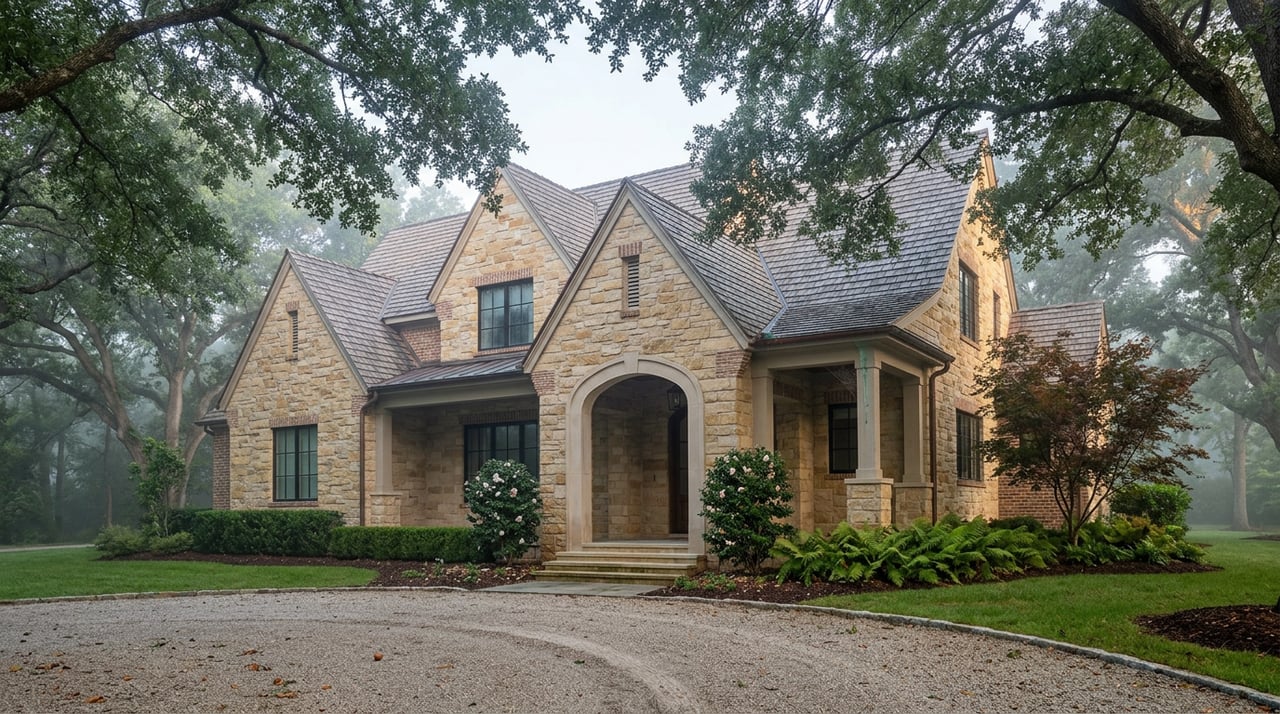
Layer a long-running teardown-and-rebuild culture on top of that scarcity and you get the pattern buyers actually encounter on the ground. Investment analysis of the neighborhood has pointed to a continuous pattern of owners tearing down older ranch houses and rebuilding larger custom homes rather than renovating around them, a pattern that keeps pushing the ceiling on what finished construction commands. Meanwhile, one architecturally unusual listing in the area, a glass-walled modern build tucked into the tree canopy, was described by its own listing copy as an "architectural outlier in a market defined by tradition." That phrase says as much about the other homes as it does about the one it describes. Tradition here usually means brick or stone, French Norman or Georgian detailing, and a lot that started life as something smaller before someone decided to start over.
Subdivisions like Tara Oaks and Memorial Estates show this pattern repeatedly: a listing built decades ago changes hands, and within a year or two a much larger custom home stands in its place. The land carried the value across that transaction. The house that got demolished did not.
There is a second piece of this that price-per-square-foot also hides: how few homes actually move here. The city's own website counts about 1,460 homes within its two square miles, and one local market analysis found that only about six homes changed hands in a typical month in 2025, across a city of roughly 1,400 households. That is not a search problem. It is a waiting problem.
Median days on market for the neighborhood ran about 40 days as of March 2026, down 13 percent from the year before. A faster median sounds like more competition for buyers, and it is, but it does not mean more choices. It means that when a lot in the right subdivision, at the right size, on the right side of Buffalo Bayou comes open, it moves quickly because there was nothing comparable sitting on the market to absorb the demand first. The median sale price for the neighborhood was reported around $2.99 million as of June 2026, up 15.3 percent year over year. Some of that appreciation is genuine. Some of it is compositional, the natural result of more teardown-grade land sales closing at land-plus-scarcity prices rather than more finished homes simply appreciating in place.
If the lot is the asset, the carrying cost of owning that asset is worth laying out plainly, because it is one of the few numbers in this market that does not move with the mix of what happens to be listed.
| Taxing Entity | Rate |
|---|---|
| City of Hunters Creek Village | 0.2052% |
| Harris County | 0.3853% |
| Spring Branch ISD | 1.0764% |
| Combined | ~1.667% |
On a $3 million purchase, that combined rate works out to roughly $50,000 a year before any exemptions are applied. The city's own portion of that bill is small relative to the school district's share, which means the real driver of a Hunters Creek Village tax bill is the enormous assessed value of the land itself, not the local millage rate. Compare a property here against a similarly sized home in a different Memorial Village and the city rate might differ by a few hundredths of a percent. It will not explain a difference of tens of thousands of dollars in annual taxes. The lot size and its assessed value will.
Once you stop treating price per square foot as the headline number, a few other details start to matter more:
Lot size relative to that 22,500 square foot zoning floor tells you whether a property has room to be rebuilt larger, or whether it is already at or near the ordinance's limit. Condition matters less for pricing purposes than it would elsewhere. A dated interior on a generous lot in Tara Oaks may be priced closer to what a finished rebuild two doors down commands than to what the current structure would fetch on its own.
Which side of Buffalo Bayou a property sits on is worth confirming directly, since most of Hunters Creek Village is zoned to Spring Branch ISD, feeding into Hunters Creek Elementary, which reopened in a new building in August 2021, then Spring Branch Middle School and Memorial High School, while a smaller southern section falls under Houston ISD instead.
The surrounding amenities, Terry Hershey Park's trails along the bayou, Lakeside Country Club and Houston Country Club, and the retail corridors at CityCentre and Memorial City Mall, are consistent across the neighborhood and rarely the deciding factor between two comparable lots. They are worth knowing about as context, not as a tiebreaker.
The Memorial Villages as a group were ranked third safest in Texas by SafeWise in February 2026, a fact worth having in hand for comparison purposes, though it says more about the collective governance structure of these six independent cities than it does about any single street inside Hunters Creek Village.
Does a lower price per square foot mean a better deal in Hunters Creek Village? Not reliably. A low number can mean a genuinely underpriced finished home, or it can mean a large, dated structure on a lot the buyer intends to demolish anyway. The number needs the lot size and the listing's own language about condition read alongside it before it means anything.
Which school district will a specific property be zoned to? Most of Hunters Creek Village falls under Spring Branch ISD. A smaller section south of Buffalo Bayou is zoned to Houston ISD instead. This is worth confirming address by address rather than assuming based on the neighborhood name alone.
How long should a buyer expect to wait for the right property? Given that roughly six homes traded hands in a typical month in 2025 across a city of about 1,400 households, patience matters more than search frequency. The right lot in the right subdivision may take longer to appear than in a larger, faster-turning market, and being ready to move when it does often matters more than continuing to search.
If you are comparing Hunters Creek Village against another Memorial Village, or against a different part of Greater Houston entirely, the lot math and the tax math both change the comparison in ways a portal search will not surface on its own. McCrory Clark Realty Team works through those specifics property by property, including a free home valuation conversation if you already own here and are weighing what the current teardown market means for your own lot.
Bringing together a team with the passion, dedication, and resources to help our clients reach their buying and selling goals. With you every step of the way. Contact us today to find out how we can be of assistance to you!
27880 Birnham Woods Dr Ste C Spring, TX 77386